
The Archaeology of a Painting:
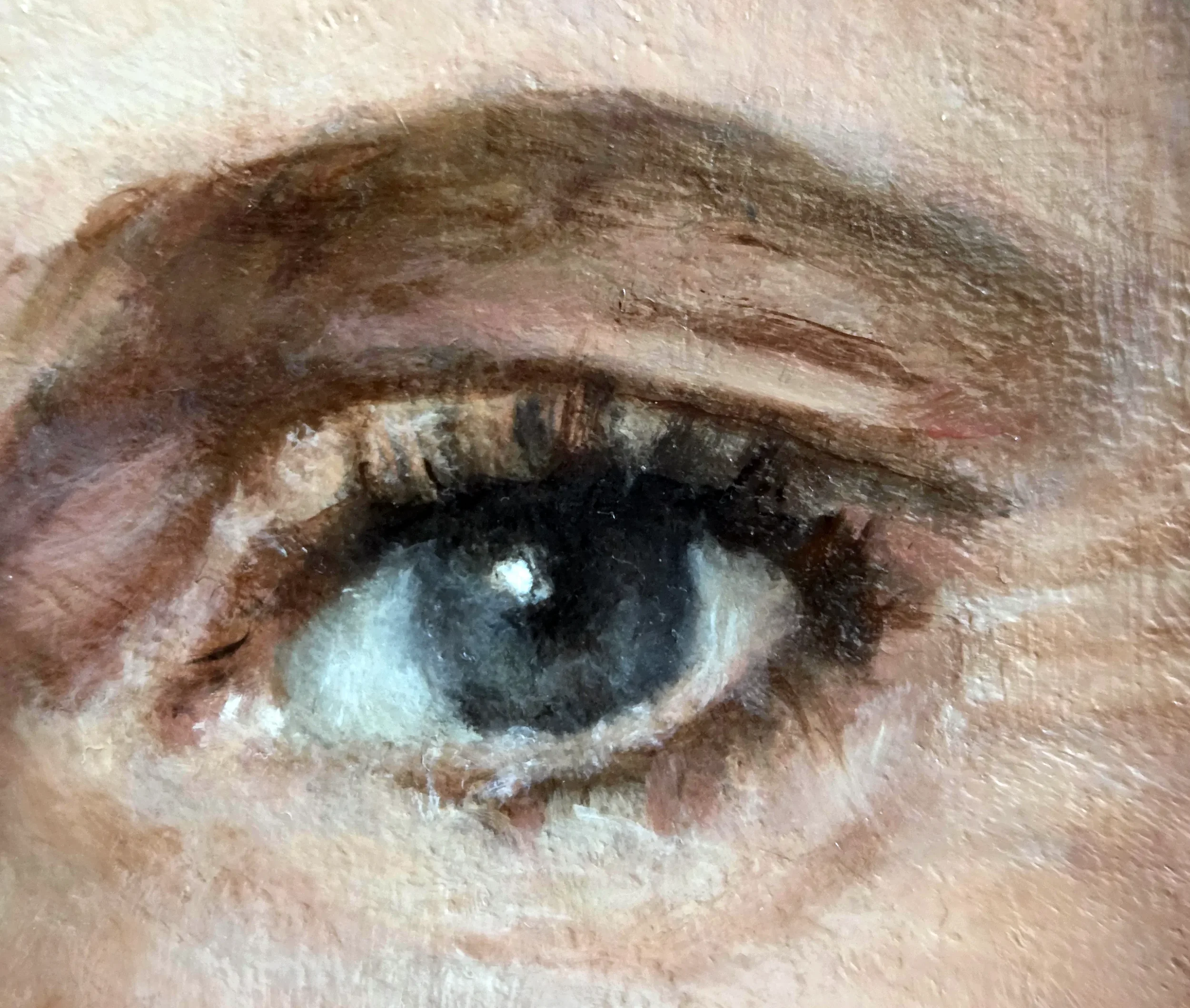
Why There Are No Shortcuts to a Living Presence
As a portrait artist, I am frequently asked what gives a painting its "living presence." People often assume it’s a matter of technical precision—getting the anatomy exactly right or matching a skin tone perfectly. But after years at the easel, I’ve realized that a living presence isn't the result of a series of perfectly executed brushstrokes; it is something that accumulates.
The Illusion of the "One-Day" Masterpiece
A painting cannot come to life in a single day. A day of painting is merely a snapshot. To instill life, you need the passage of time and the emotional "up and down" of the process. The studio is often a battlefield of contradictions and conflicts.
It is a constant Tug of War. One day, the eyes are perfect, but the rest of the face is a ghost. The very next day, those same eyes feel like lead, and I have to tear them down to save the rest of the composition. I am constantly pushing and pulling pigment, trying to keep the work in that elusive "sweet spot" of harmony where everything finally decides to play well together.
A Fractured Mess of Greatness
The evidence of this tension is palpable when you stand in front of a museum-quality masterpiece. You can actually feel the weight of a painting that sat on the edge of failure. This is something a single day of work—or a single lifetime of shortcuts—can’t replicate.
Just as a painting cannot be perfected in a day, an artist cannot master this battlefield without a lifetime of persistence. Most people don’t realize that this is exactly why a digital screen can’t replicate the experience of seeing a great painting in person. On a screen, you are only looking at the top layer. In person, you are looking at a fractured mess of greatness and failure.
The Archaeology of the Surface
This happens because as you peer through the initial surface, your eye begins an archaeological dig. Subliminally, you see the evidence of the struggle:
- The "bad" layers that had to be sacrificed.
- The corrections, the shifts in light, and the pentimenti (the traces of earlier marks).
- The physical depth of the pigment built up over weeks or months.
This archaeology of paint is the true substance of the work. It creates a visual vibration that the human eye detects as "life" because it is the life—the literal record of the painting being brought into the world. It’s not unlike pregnancy: there is going to be pain, and there is going to be a struggle, but it is the only way to reach the end.
Why Digital Feels Flat
This is why a digital presentation can feel so dead. A screen flattens the history of the piece into a single, glowing plane. It strips away the three-dimensional record of the artist's persistence.
Conversely, this is also why mediocre, "flat" paintings often look better on a smartphone than they do in a gallery—the screen provides an artificial, digital complexity that the physical object lacks. In person, there is no hiding. The canvas either has the history, or it doesn't.
No Shortcuts to the Soul
There is no "hack" for a living presence. You cannot glaze your way into a soul, and you cannot fake the depth that comes from genuine struggle. You simply have to buckle up, stay in the chair, and persist until the paint finally reflects the complexity of a human life.